How to Stop Hourly Billing and Start Value-Based Pricing in 5 Steps
September 13, 2026 · 8 min read
Hourly billing feels safe. You track your time, multiply it by your rate, and send the invoice. But “safe” can become a very expensive habit. When you bill by the hour, clients are buying your time instead of the result you create. You earn
Hourly billing feels safe. You track your time, multiply it by your rate, and send the invoice.
But “safe” can become a very expensive habit.
When you bill by the hour, clients are buying your time instead of the result you create. You earn less when you become faster, your income is limited by your calendar, and every proposal can turn into a negotiation over your day rate.
Value-based pricing offers a better alternative: price your engagement around the economic value of solving the client’s problem.
That does not mean charging an arbitrary premium or pretending every result is perfectly measurable. It means understanding what is at stake, defining the outcome, and setting a fee that is proportional to the value you can reasonably defend.
Here’s how to stop hourly billing without turning your pricing process into guesswork.
1. Stop selling hours, but keep the math for yourself
The first step in learning how to stop hourly billing is separating your internal calculations from your client-facing offer.
Your hourly rate can still be useful as a private floor. It helps you avoid accepting work that will damage your margins. It can also reveal whether a project is financially viable based on your capacity, expenses, taxes, and desired income.
What it should not do is determine the price your client sees.
Hourly pricing creates a few awkward incentives:
- You earn less when your experience helps you work faster.
- Clients may question efficient work because fewer hours can look like less value.
- Scope discussions focus on tasks and time instead of business outcomes.
- Your revenue is capped by the number of hours available in your calendar.
Instead, use your internal rate as a sanity check. Then present the engagement as a fixed project or engagement fee tied to a defined result.
For example, you might internally estimate that a project will require 30 hours. That estimate can help you decide whether a $3,000 fee protects your margin. But your proposal should focus on what the client receives: a completed diagnostic, a prioritized action plan, implementation support, or a measurable improvement.
The hour is your backstage calculator, not the headline act.
2. Quantify the cost of the problem
You cannot price consulting services based on value if you do not know what the problem is worth to the client.
Before discussing deliverables, ask questions that uncover the financial and strategic stakes:
- What is the problem costing the business each month?
- How long has it been happening?
- What happens if nothing changes for the next six or twelve months?
- What would a successful outcome make possible?
- How much revenue, time, or risk could the improvement affect?
- How confident is the client that the desired result can be achieved without help?
The most useful number is often the cost of inaction: the value the client loses while the problem remains unresolved.
Suppose a client estimates that a broken sales process is costing them $4,000 per month. If the issue continues for 12 months, the cost of waiting is $48,000.
That does not automatically mean you should charge $48,000. It does give you a defensible value anchor. Your fee can then reflect the scope of your involvement, the expected impact, the client’s risk, and the speed at which you can help them move forward.
A good value conversation is not about inflating the problem. It is about making the problem visible.
PropelQuote helps you turn those conversations into an actual calculation. You can compare four ROI frameworks, cost of inaction, time-to-value, expected value, and the three-tier dividend model, as you enter the client’s numbers.
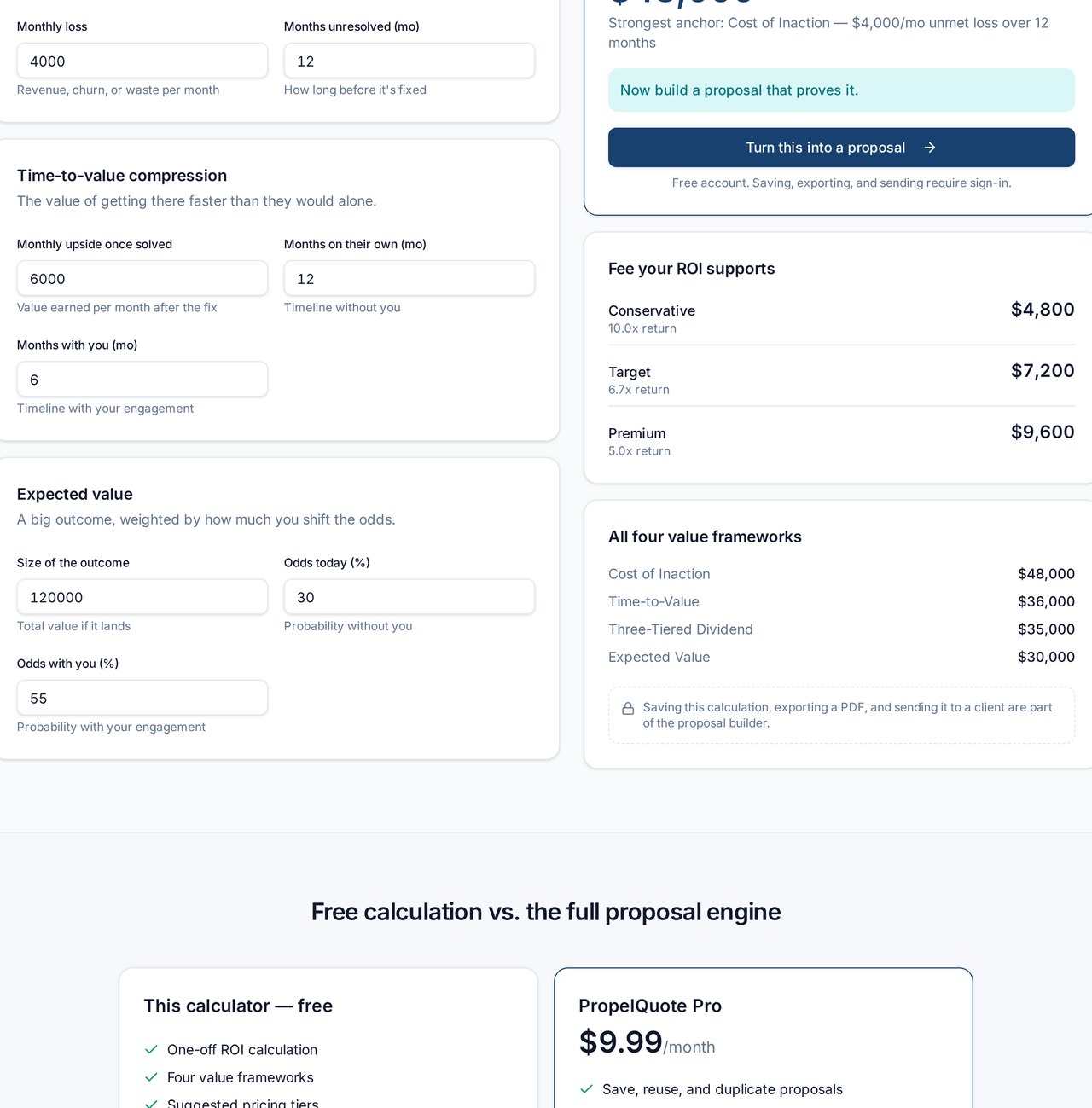
If you want to experiment before building a proposal, try the free ROI calculator.
3. Turn your service into a defined offer
The next step in your consultant pricing strategy is packaging what you do.
Start with one repeatable service. Choose an engagement where:
- The client’s problem is familiar.
- The scope can be described clearly.
- You have delivered something similar before.
- The likely outcome is easier to explain.
- You can identify reasonable boundaries and assumptions.
Then give the service a name and define it around the client’s destination, not your activity.
Compare these two descriptions:
“Ten hours of strategic consulting”
and:
“A 30-day customer acquisition audit with a prioritized growth plan and implementation roadmap”
The second description is easier to understand, easier to scope, and easier to price based on value.
Your offer should explain:
- The problem being addressed.
- The outcome or change the client is pursuing.
- The deliverables included.
- The timeline or working period.
- What the client must provide.
- What is outside the scope.
Clear scope protects both sides. Value-based pricing does not mean agreeing to unlimited work for one fixed fee. It means agreeing on the value of a defined engagement.
If you sell several services, create a reusable service library. In PropelQuote, you can save deliverables with anchor rates and add them to new proposals without rebuilding your pricing from scratch every time.
That gives you consistency without forcing every client into the exact same package.
4. Build three pricing options around the value anchor
One price can make a proposal feel like a yes-or-no decision. Three thoughtful options give the client room to choose the level of impact, support, and speed that fits their situation.
A simple structure might look like this:
- Conservative: diagnosis and a focused plan.
- Target: diagnosis, strategy, and implementation support.
- Premium: deeper involvement, faster progress, optimization, or ongoing advisory support.
The options should not be random bundles of extra meetings. Each tier should represent a meaningful difference in ownership or expected outcome.
For example:
| Option | Best for | Possible inclusions |
|---|---|---|
| Conservative | Clients who need clarity | Audit, findings, and prioritized roadmap |
| Target | Clients ready to act | Audit, strategy, implementation support, and review |
| Premium | Clients seeking a partner | Full implementation, optimization, reporting, and ongoing advisory |
The pricing advisor in PropelQuote suggests conservative, target, and premium tiers from the value you calculate. That gives you a starting point instead of asking, “What number feels brave today?”
You can then adjust for complexity, urgency, access, risk, and the level of responsibility you are taking on.
The goal is not to force every client into the premium option. The goal is to make the difference between options obvious enough that the client can choose based on what they want to accomplish, not simply pick apart your hourly rate.
For more background on consulting fees and value-based pricing, see Consulting Success’s consulting fees guide and its overview of value-based pricing for consultants.
5. Present the value clearly and make it easy to say yes
Your proposal should connect the dots:
- Here is the problem.
- Here is what it is costing you.
- Here is the outcome we are pursuing.
- Here is what the engagement includes.
- Here are the investment options.
- Here are the terms and next steps.
Avoid burying the value calculation in a spreadsheet or mentioning your estimated hours as a justification. The client does not need to see every internal assumption behind your price. They do need enough context to understand why the investment is reasonable.
A polished proposal should also include:
- Specific deliverables and quantities.
- Success measures or expected outcomes.
- Timeline and responsibilities.
- Payment schedule.
- Scope-change terms.
- Cancellation or exit terms.
- Acceptance and signature details.
PropelQuote turns this information into a client-ready document with scope, investment breakdown, and an optional value-realization summary. You can offer two or three tiers and show the projected return against the value anchor.
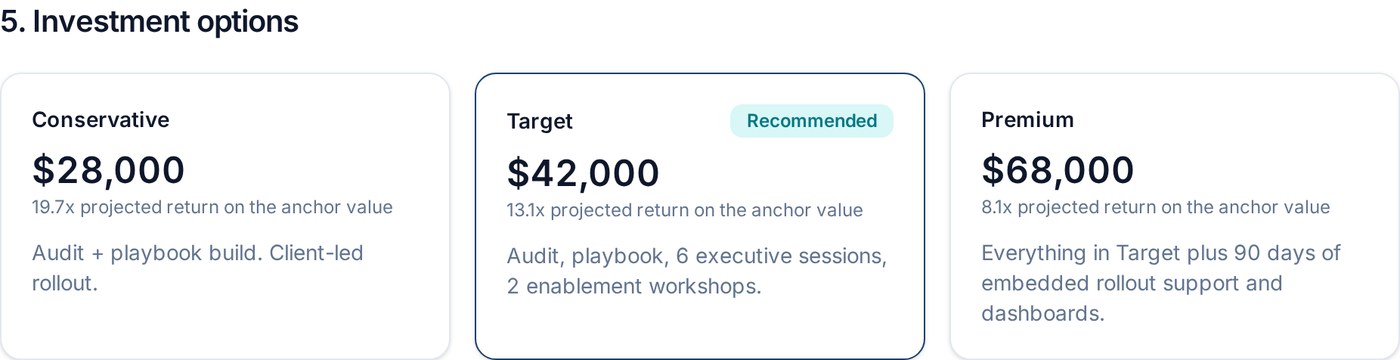
There is also a private margin check for you: not the client: that flags proposals where your price exceeds the defensible value. It is a useful guardrail when you are excited about a project and tempted to price from either panic or optimism.
Once the client is ready, you can send a shareable proposal link. They can review the terms, type their name as an e-signature, and accept digitally.
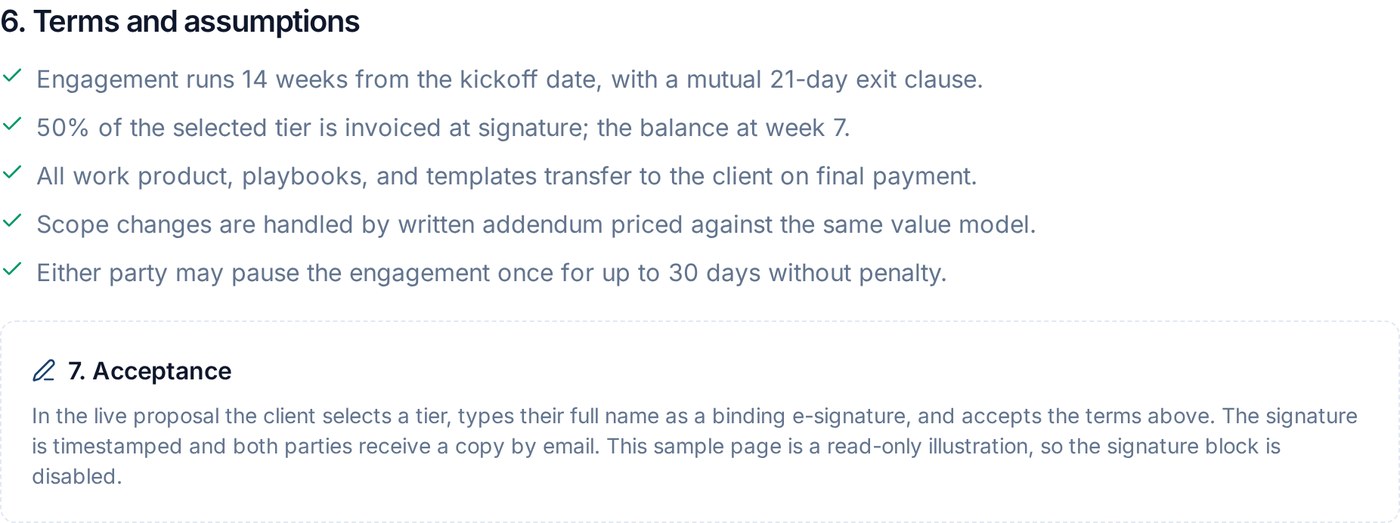
Pro users can attach a Stripe or PayPal payment link, so the client can pay directly from the proposal instead of wandering through a separate checkout process.
How to transition existing clients away from hourly billing
You do not need to change every client and every service overnight.
Start with your next suitable project. Explain that you are moving toward fixed engagement fees because they offer clearer scope, predictable budgeting, and better alignment around outcomes.
You might say:
“I’m updating how I structure projects. Instead of billing by the hour, I’m quoting a fixed engagement fee based on the outcome, scope, and level of support involved.”
Review your last six to twelve months of work and look for patterns:
- Which engagements repeat?
- Which clients received the clearest results?
- Where did scope creep appear?
- Which projects were profitable?
- Which outcomes can you quantify?
Use those patterns to refine your packages and pricing.
An internal freelance pricing calculator can still help you check your minimum viable fee. But your client-facing pricing should be anchored in the result and the value of solving the problem: not in the number of hours you expect to spend.
Stop renting out your calendar
Hourly billing makes your calendar the product.
Value-based pricing makes your expertise, judgment, and ability to create a meaningful result the product.
The transition takes practice. You will need better discovery questions, clearer offers, stronger scope boundaries, and a repeatable way to calculate value. But you do not have to figure out every proposal from a blank page.
PropelQuote Pro helps you quantify the cost of inaction, compare ROI frameworks, generate conservative/target/premium pricing tiers, reuse your service library, check your private margins, and send a polished proposal clients can sign and pay from.
Create your free PropelQuote account and start building your first value-based proposal. No card required, and the free plan includes up to three proposals.