The Consulting Proposal Template That Prices Itself: A Value-Anchored Structure Clients Say Yes To
October 1, 2026 · 8 min read
A consulting proposal should do more than describe your services. It should help the client understand: What problem needs solving What that problem is costing them What outcome they are buying Why your recommended fee is reasonable Which l
A consulting proposal should do more than describe your services.
It should help the client understand:
- What problem needs solving
- What that problem is costing them
- What outcome they are buying
- Why your recommended fee is reasonable
- Which level of support fits their goals
That is the difference between a document that lists deliverables and a consulting proposal template that prices itself.
“Prices itself” does not mean the software invents a magical number. It means the fee is built from the client’s own economics: the cost of inaction, the value of reaching the outcome faster, the expected upside, and the likely dividend from your work.
This structure is especially useful if you are learning how to price consulting services, moving away from hourly billing, or developing a more defensible B2B pricing strategy.
The value-anchored consulting proposal structure
A strong proposal follows this sequence:
- The client’s current situation
- The cost of leaving it unchanged
- The desired outcomes
- The scope of your engagement
- The investment options
- The timeline and terms
- The next step
The crucial shift is that pricing appears after value has been established.
Instead of opening with “My rate is $200 per hour,” you show the client that an unresolved problem may be costing $4,000 per month. That creates a much more useful conversation.
Running example: a $48,000 cost of inaction
Imagine a sales consultant working with a boutique B2B firm. The firm estimates that its inefficient follow-up process is causing approximately $4,000 in lost margin every month.
The problem has been present for 12 months.
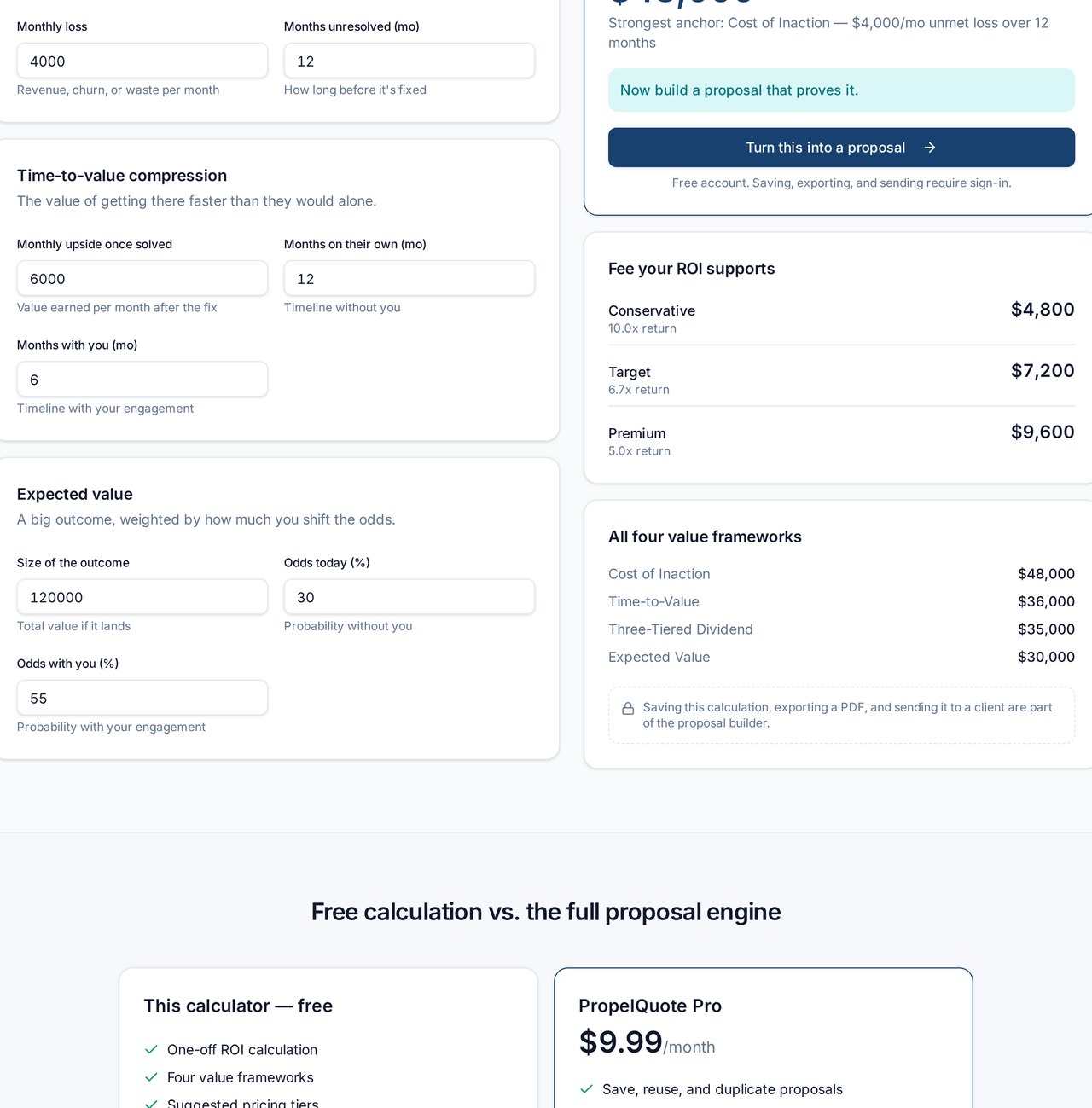
Monthly cost of inaction: $4,000
Months unresolved: 12
Annual cost of inaction: $4,000 × 12 = $48,000
The $48,000 is not a promise that the consultant will create exactly $48,000. It is the client-confirmed value anchor for the proposal.
For more context, read How to Stop Hourly Billing and Start Value-Based Pricing in 5 Steps.
Section 1: Current situation and cost of inaction
Start the proposal with the client’s world, not your biography.
Use language that reflects what the client told you:
“Your current follow-up process is creating delays between qualified opportunities and sales conversations. Based on the figures discussed, the resulting margin leakage is approximately $4,000 per month.”
Then make the cost of delay visible:
“If the current process remains unchanged for the next 12 months, the estimated cost of inaction is $48,000.”
This section gives the client a financial reason to act now. It also prevents your price from floating in isolation.
Your cost of inaction calculator can use revenue leakage, churn, waste, missed opportunities, or avoidable costs. The number does not need to be perfect. It needs to be transparent, sourced from the client, and clearly labeled as an estimate when appropriate.
You can test the numbers in the free ROI calculator before turning them into a proposal.
Section 2: Desired outcomes
Next, describe what changes when the engagement succeeds.
For the running example, the desired outcomes might be:
- Create a clearer lead follow-up process
- Reduce delays between inquiry and sales contact
- Recover a meaningful portion of the estimated margin leakage
- Give the internal team a repeatable workflow and measurement system
Avoid claiming certainty where you do not have it. A proposal can be commercially confident without pretending consulting outcomes are guaranteed.
A useful outcome statement might be:
“The engagement is designed to help the team recover a substantial portion of the value currently lost through follow-up delays, while creating a process the business can continue using after the project ends.”
This is also where you can identify the primary value framework. But you do not have to rely on only one.
Section 3: Use four ROI frameworks to test the value
PropelQuote supports four ROI frameworks. Each one looks at the engagement from a different angle.
1. Cost of inaction
This measures what the client loses while the problem remains unresolved.
For the running example:
$4,000 monthly loss × 12 months = $48,000
This is often the safest anchor because it is easy for the client to understand and verify.
2. Time-to-value
This measures the value of reaching the desired result sooner.
Suppose the client believes the improved process could produce $6,000 of monthly benefit once fully implemented. Without help, they estimate it would take 12 months. With the consultant’s support, the target timeline is six months.
6 months accelerated × $6,000 monthly value = $36,000
That $36,000 represents the economic value of reducing the wait.
3. Expected value
Expected value is useful when the outcome is meaningful but uncertain.
Suppose the client estimates:
- Potential outcome: $100,000
- Probability without the engagement: 20%
- Probability with the engagement: 50%
The consultant’s contribution to expected value is the probability lift:
($100,000 × 50%) − ($100,000 × 20%) = $30,000
This framework is helpful for strategy, growth, transformation, and other engagements where the result depends on multiple variables.
4. Three-tier dividend model
The three-tier dividend model presents conservative, target, and premium value scenarios.
For the $48,000 value pool:
| Dividend tier | Realization assumption | Dividend value |
|---|---|---|
| Conservative | 50% of available value | $24,000 |
| Target | 75% of available value | $36,000 |
| Premium | Up to 100% of available value | $48,000 |
These are scenarios, not promises. The client may choose a deeper engagement because they want more implementation support, faster time-to-value, or greater confidence in adoption.
Read The Three-Tier Dividend Model: What It Is and How to Calculate It in 5 Easy Steps for a deeper walkthrough.

Section 4: Scope, define what the client is buying
Value-based pricing still requires precise scope.
The client is not paying for unlimited access to your brain. They are buying a defined engagement designed to create a defined change.
For the running example, the scope could look like this:
Phase 1: Diagnose
- Review the current sales follow-up process
- Interview key team members
- Analyze response-time and conversion data
- Identify the largest sources of margin leakage
Phase 2: Design
- Create the new follow-up workflow
- Define ownership and handoff points
- Build scripts, templates, and reporting metrics
- Document implementation requirements
Phase 3: Implement and optimize
- Train the sales team
- Support rollout for 30 days
- Review early performance
- Recommend process adjustments
Also list what is excluded:
- CRM software implementation
- Copywriting beyond the agreed templates
- Ongoing sales management
- Additional workshops outside the stated schedule
Clear boundaries make a fixed fee feel safer for both sides.
If you sell similar services repeatedly, use a reusable service library. Save deliverables with anchor rates, then drop them into a new proposal, adjust quantities, and let the math follow. You get consistency without forcing every client into an identical package.
Section 5: Investment breakdown with conservative, target, and premium tiers
Now translate the value anchor into pricing options.
A practical starting point is:
| Option | Scope | Fee | Best for |
|---|---|---|---|
| Conservative | Diagnosis and prioritized action plan | $4,800 | Clients who need clarity first |
| Target | Diagnosis, design, and implementation support | $7,200 | Clients ready to act |
| Premium | Full implementation, optimization, and advisory | $9,600 | Clients seeking deeper partnership |
These fees represent 10%, 15%, and 20% of the $48,000 anchor.
That gives the client an attractive return while giving you a defensible starting point for pricing. The percentages are not laws. Adjust them for complexity, urgency, risk, access, delivery cost, and your track record.
PropelQuote’s pricing advisor suggests conservative, target, and premium tiers from the calculated value. You can then refine the scope and investment based on the actual engagement.
The important thing is that each tier changes the level of responsibility or expected support. Do not create three options by adding random meetings and decorative deliverables. Make the tradeoffs meaningful.
Section 6: Optional value-realization summary
Some clients want to see the financial logic summarized. Others prefer a simpler proposal.
That is why the value-realization summary should be optional.
For the running example, it might say:
“Based on the client’s estimate of $4,000 in monthly margin leakage, the current 12-month cost of inaction is approximately $48,000. The target engagement is priced at $7,200, representing a potential 6.7× value-to-fee relationship if the target value scenario is realized.”
Keep assumptions visible. Do not turn a planning estimate into a guarantee.
This section is especially useful for executive buyers, procurement teams, or clients comparing the proposal against internal investment priorities.
Section 7: Protect your margin privately
A value-based fee can still be a bad deal if the work takes too long or includes too much delivery risk.
Before sending the proposal, check:
- Estimated delivery cost
- Contractor or software costs
- Time required from you
- Likely scope changes
- Payment timing
- Minimum acceptable margin
PropelQuote includes a private margin check that flags proposals where your price exceeds the defensible value or where the engagement may not be commercially healthy.
The client does not need to see your internal margin math. They need a clear scope, credible value case, and understandable investment options.

Section 8: Make acceptance and payment easy
A strong proposal should not lose momentum after the client says yes.
Include:
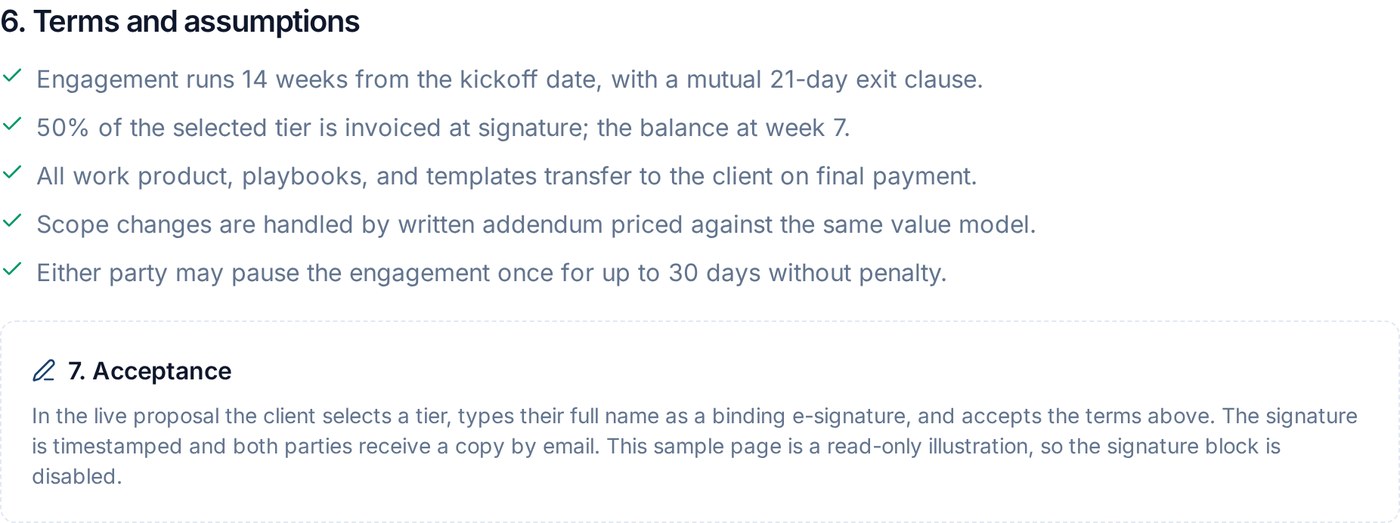
- Acceptance terms
- Signature or typed e-signature
- Payment schedule
- Start date
- Responsibilities
- Cancellation and scope-change terms
Pro users can attach a Stripe or PayPal payment link so the client can pay directly from the proposal. No separate invoice scavenger hunt required.
The complete value-anchored proposal template
Use this outline for your next consulting proposal:
1. Executive summary
2. Current situation
3. Cost of inaction
4. Desired outcomes
5. ROI and value assumptions
6. Scope and deliverables
7. Conservative, target, and premium options
8. Investment breakdown
9. Timeline and responsibilities
10. Optional value-realization summary
11. Terms and acceptance
12. Payment link and next steps
The result is a proposal that answers the client’s real questions:
- Why does this matter now?
- What happens if we wait?
- What exactly are we buying?
- Which option fits our goals?
- How does the fee relate to the value?
- How do we get started?
That is how a consulting proposal starts to “price itself.” You are not pulling a number from thin air. You are connecting the fee to a value anchor, testing it through multiple ROI frameworks, and presenting the client with sensible choices.
Use PropelQuote’s consulting proposal template, try the free ROI calculator, or create a free account to build your first value-based proposal.