Value-Based Pricing vs Hourly Billing: Which Actually Pays You More?
October 15, 2026 · 7 min read
By Kennon C. Bauman, founder of PropelQuote
Value-based pricing usually pays more when the client's value is measurable and the work is well scoped: a $48,000 cost of inaction supports fees of $4,800 to $9,600, versus $6,000 for 30 hours at $200. Hourly billing is the safer choice when the scope is genuinely unpredictable or the client is buying flexible access.
If you bill by the hour, your revenue has a built-in ceiling: your rate multiplied by the hours you can sell. Value-based pricing changes the question from “How long will this take?” to “What is solving this worth to the client?”
Value-based pricing can mean better consulting income for the same work, but higher income isn’t automatic. The right model depends on how clearly you can define the scope, measure the value, and manage delivery risk. Here’s the honest math.
Hourly billing vs. value-based pricing at a glance
| Hourly billing | Value-based pricing | |
|---|---|---|
| Income ceiling | Rate × available billable hours | Tied to defensible client value, not directly to your calendar |
| Efficiency incentive | Faster work can mean less revenue | Faster, better delivery can improve your margin |
| Client perception | Often focuses attention on time and rate | Centers the conversation on outcomes and investment |
| Scope creep risk | Extra hours may be billable, but can create friction | Needs clear deliverables, assumptions, and change terms |
| Pricing conversation | “How many hours will this take?” | “What is the problem costing, and what result are we pursuing?” |
| Scalability | Growth often requires more billable capacity | Repeatable offers and efficient delivery can increase capacity |
The short version: value-based pricing has more upside when the client’s value is measurable and the work is well scoped. Hourly billing can be the safer choice when the work is genuinely unpredictable or the client is buying flexible access.
The math: which model pays more?
With hourly billing, the basic formula is:
Hourly rate × billable hours = revenue
Suppose you charge $200 an hour and can sell 1,000 hours in a year. Your gross billings are capped at $200,000, before expenses, taxes, unpaid sales time, and other nonbillable work. To increase that ceiling, you generally need to raise your rate, sell more hours, or add delivery capacity.
And efficiency can work against you. If experience lets you complete in 10 hours what used to take 20, the client gets the same result in less time, but your invoice falls by half if you’re still charging by the hour.
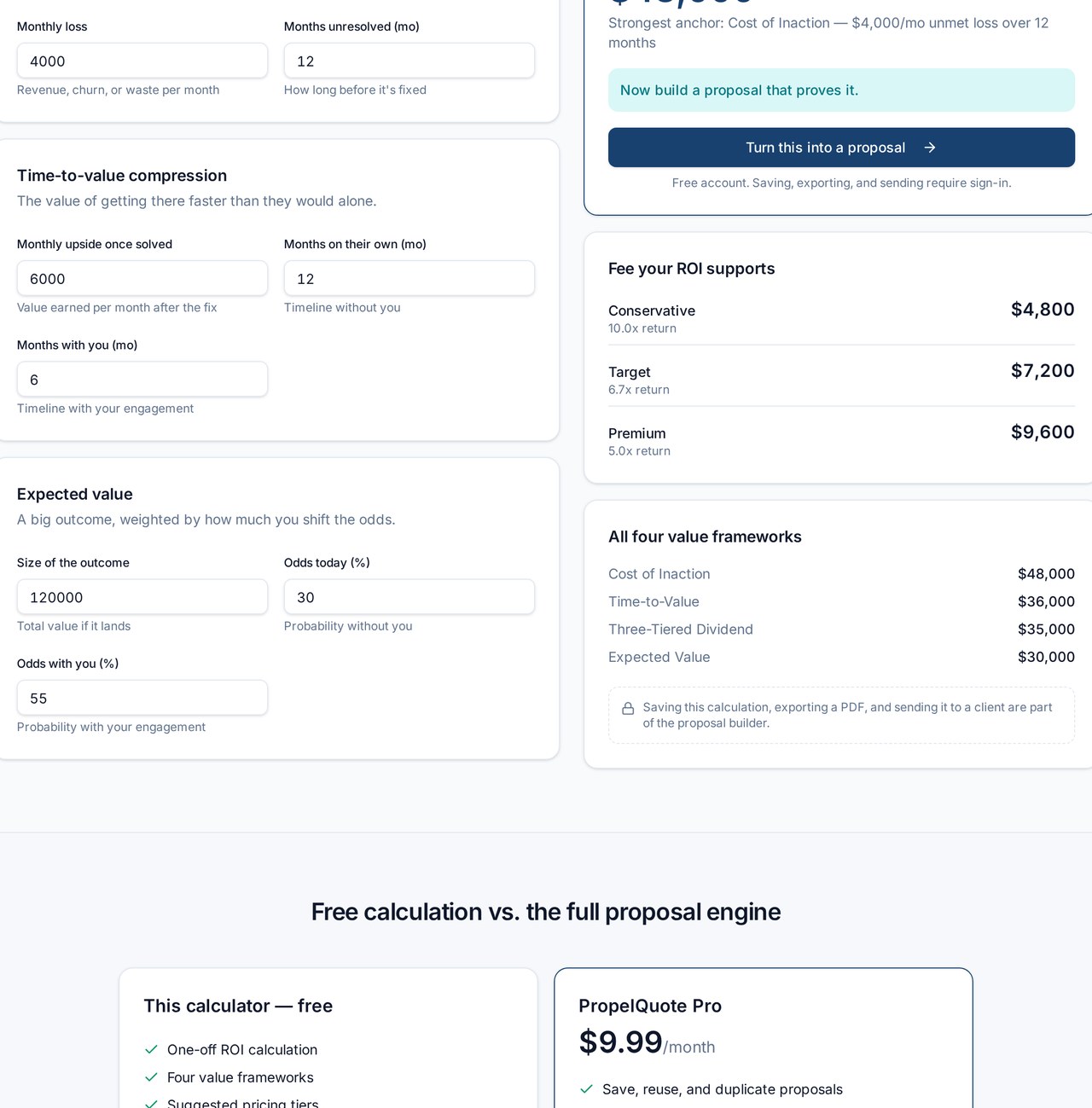
Value-based pricing starts with the client’s result instead. Consider a client who confirms they’re losing $4,000 per month and expects the problem to persist for 12 months if it remains unresolved:
$4,000 × 12 months = $48,000 in cost of inaction
One practical value-based pricing approach is to use a defensible share of the $48,000 cost-of-inaction anchor to create fee options:
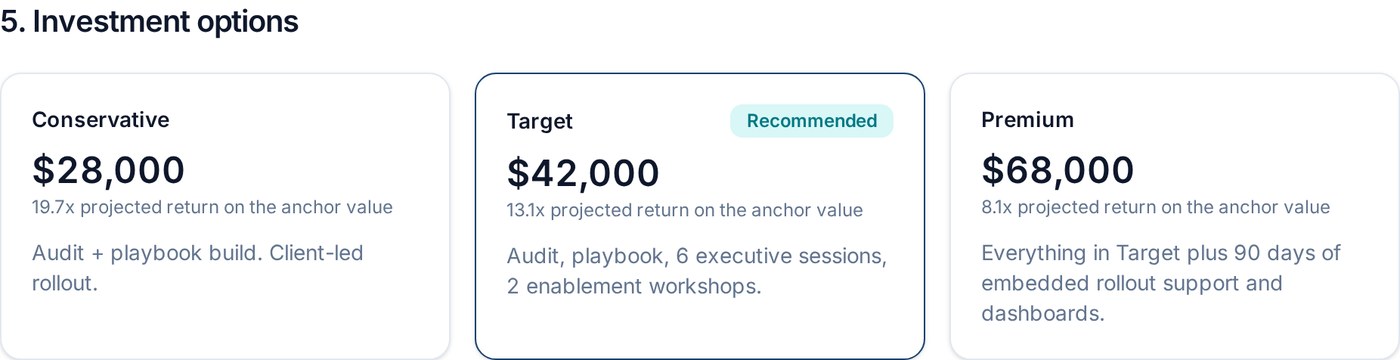
| Tier | Share of $48,000 anchor | Fee |
|---|---|---|
| Conservative | 10% | $4,800 |
| Target | 15% | $7,200 |
| Premium | 20% | $9,600 |
The 10% conservative, 15% target, and 20% premium fee shares are a useful starting framework, not a universal rule or a promise that the client will realize the full anchor. Confirm the inputs with the client, explain the assumptions, and match the fee to your scope, contribution, and delivery risk.
For a direct comparison, imagine the engagement takes 30 hours. At $200 per hour, you would bill $6,000. The $4,800 conservative value-based option would pay less than that. The $7,200 target and $9,600 premium options would pay more for those same 30 hours, if the client sees the value, accepts the scope, and the engagement delivers as planned.
For a 30-hour engagement, the $7,200 target and $9,600 premium value-based fees beat the $6,000 hourly quote, while the $4,800 conservative fee does not. Value-based pricing can pay more, but not every value-based fee beats every hourly quote. Its upside is that your fee is no longer mechanically tied to time. Its risk is that you must estimate the value and control the work responsibly.
How to build a value anchor you can defend
A value-based fee is only as credible as the reasoning behind it. Start with numbers the client can confirm, and be candid about estimates. PropelQuote’s four frameworks offer different ways to think about the value at stake:
- Cost of inaction: How much is the problem costing while it remains unsolved? In our example, $4,000 per month over 12 months produces a $48,000 anchor. See the cost of inaction framework for the calculation and common pitfalls.
- Time-to-value: What is the value of reaching the outcome sooner? If the client would reach a useful result on their own in 12 months, but your work helps them get there in six, the value of those six months may be part of the case.
- Expected value: If your work changes the likelihood of a significant outcome, compare the expected value before and after. Be clear about the probabilities and avoid presenting uncertain outcomes as guaranteed.
- Three-tier dividend model: Look beyond immediate financial gains to include the lasting value of systems, processes, or capabilities your work leaves behind.
PropelQuote’s cost-of-inaction, time-to-value, expected value, and three-tier dividend frameworks may produce different value estimates. That’s useful: the goal is not to cherry-pick the biggest number, but to understand the range and choose an anchor you can explain.
Once you have an anchor, a pricing advisor can help translate it into conservative, target, and premium options. The tiers work best when each represents a meaningful difference in scope, support, speed, or responsibility, not simply three prices attached to the same package.
For more on the method, read value-based pricing for consultants.
When hourly billing still makes sense
Value-based pricing is not a mandate to force every project into an outcome fee. Hourly or time-and-materials pricing can be reasonable when:
- The scope is genuinely undefined. Early discovery, troubleshooting, or exploratory work may reveal what the real project is. Start with a short paid diagnostic or a capped hourly phase, then price the next stage once the scope is clearer.
- The client is paying for ongoing access. A retainer can work when requests vary and the client needs a defined level of availability. Set clear expectations around response times, capacity, and what is included.
- The work is driven by unpredictable events. Litigation-style support, urgent investigations, or changing third-party demands may be difficult to scope reliably in advance.
Hourly billing can also be fair when the client controls the pace or decisions that determine how much work is needed. The key is to be explicit about what’s uncertain, how hours will be approved, and whether you’ll set a budget or cap.
Switching models without making it weird
You don’t need to overhaul your entire business overnight. A measured transition gives you room to test your offers and learn from real proposals.
- Start with new clients. Choose a repeatable engagement with a clear problem and a result you can describe. Package the deliverables, timeline, assumptions, and exclusions.
- Keep your hourly math backstage. Estimate your likely effort and check that the proposed fee meets your margin needs. Use the estimate as an internal guardrail, not as the main reason for the client-facing price.
- Offer clear tiers. Give clients a choice between different levels of support or impact. Spell out what each option includes so they can compare the investment with the outcome.
- Migrate existing clients thoughtfully. Don’t surprise someone midway through an engagement. At renewal or before a new project, explain that you’re moving toward fixed engagement fees tied to defined scope and outcomes.
- Track what happens. Review delivery time, scope changes, profitability, and client results. Adjust your packages and assumptions based on evidence.
A practical consultant pricing strategy often uses more than one model: value-anchored fixed fees for defined engagements, and hourly or capped discovery phases when uncertainty is too high. If you’re deciding how to stop hourly billing, transition one suitable service first and refine it before changing everything else.
The bottom line
Hourly billing can give you a straightforward way to charge for open-ended work, but it puts a hard limit on income and can penalize efficiency. Value-based pricing can let your revenue grow beyond the hours on your calendar, but only when the client value is credible, the scope is clear, and your fee reflects the real delivery risk.
To improve your B2B pricing strategy or decide how to price consulting services, start with the client’s confirmed numbers. Build an anchor, check it against your delivery costs, define the work, and present options that make the investment understandable.
Try the free ROI calculator to compare cost of inaction, time-to-value, expected value, and the three-tier dividend model. When you’re ready to turn the numbers into a proposal, create a free PropelQuote account.